Comet Interceptor Monitoring & Evaluation Support
know.space provided independent monitoring and evaluation support to the UK Space Agency for its national investment in Comet Interceptor, ESA’s first fast-class mission and the first designed to intercept a pristine comet. Our work assessed delivery progress and the early scientific, reputational, skills and innovation benefits associated with the UK’s leadership role in the mission.
A report for the UK Space Agency.
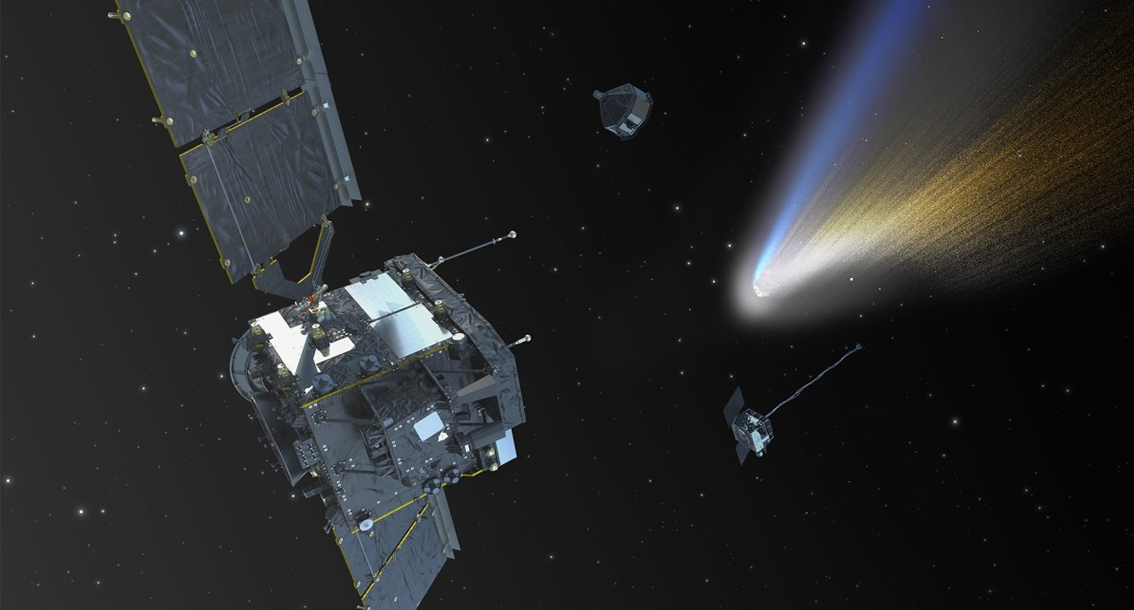
ESA’s Comet Interceptor. Credit: ESA
.project
Comet Interceptor is a pioneering European Space Agency mission, developed in collaboration with JAXA and planned for launch in 2029 alongside the Ariel space science mission. Rather than launching towards a pre-selected object, the mission will wait at Lagrange Point 2 until a suitable pristine comet is discovered, before conducting a high-speed, multi-probe fly-by to study its composition, structure and interaction with the solar wind. A pristine comet may contain material largely unchanged since the formation of the solar system. By examining such an object for the first time, Comet Interceptor could provide new evidence about how planets and planetary systems formed.
The UK has played a leading role in the development of the mission, supported by £16 million of planned national funding from the UK Space Agency. This investment has secured UK scientific influence through the University of Edinburgh and University College London, including an Interdisciplinary Scientist role, as well as leadership of two key instruments: MIRMIS, led by the University of Oxford, and the Fluxgate Magnetometer, led by Imperial College London.
know.space was commissioned to provide independent monitoring and evaluation support over more than two years. Our work examined whether UK-funded activities were being delivered effectively, whether investment objectives were on course to be achieved, and what early benefits were beginning to emerge as the mission progressed towards launch.
Key findings
The evaluation identified early progress across the UK Space Agency’s scientific, technical and reputational objectives. Whilst many of Comet Interceptor’s most substantial benefits will only emerge after the mission returns data, UK national funding has already secured influential leadership roles and positioned UK researchers and organisations to derive future value from the mission.
164 Comet Interceptor-related publications identified: preparatory research is beginning to establish the mission’s scientific foundations, with UK-based authors featuring in 39% of identified publications.
26 international research partner countries: UK researchers collaborated with researchers from 26 countries during the analysis period, reflecting the international reach associated with the UK’s mission roles.
45 engagement activities across 13 countries: project team members have undertaken conference, outreach and public engagement activity spanning four continents, helping build awareness of the mission and its science.
£150,000 in early export and revenue opportunity: the University of Oxford sold filters derived from the MIRMIS instrument design to a US company, providing early evidence of commercial potential from UK instrument development.
The evaluation also identified risks requiring continued attention, including uncertainty over long-term funding, constrained resources, retention of specialist expertise and the mission’s dependence on the launch schedule of its rideshare partner, Ariel.
.methodology
Evaluating Comet Interceptor required an approach capable of assessing progress long before the mission reaches its principal scientific phase. As the spacecraft is not expected to launch until 2029, the most significant research impacts will arise later, when the mission encounters its target and data become available to the scientific community. Our evaluation therefore focused on whether the UK’s investment was creating the leadership, capabilities, partnerships and delivery conditions required for those future benefits to be realised.
-
We consulted stakeholders across the UK-funded project team and wider mission governance landscape. Interviews provided evidence on delivery progress, scientific leadership, collaboration, skills development, commercial opportunities, resourcing pressures and risks to future benefit realisation.
-
We applied a real-time evaluation approach to capture delivery lessons while the mission was progressing. This enabled us to identify emerging issues, examine how management and governance arrangements were functioning, and develop timely recommendations relevant to later mission phases and future UK Space Agency-funded missions.
-
We developed a repeatable monitoring approach aligned with the UK Space Agency’s benefits framework for Comet Interceptor. Indicators were tracked at six-monthly intervals, covering scientific knowledge and competitiveness, international collaboration and reputation, skills and inspiration, and emerging innovation benefits.
-
We analysed publication, authorship, collaboration and citation data using the NASA Astrophysics Data System, supplemented by UK Space Agency Researchfish evidence. This allowed us to assess the emerging research profile of Comet Interceptor, UK involvement in relevant publications and patterns of international scientific collaboration. We also assessed broader online attention associated with selected Comet Interceptor research outputs, including news coverage and references in publicly accessible sources. This provided supplementary evidence of emerging visibility and engagement beyond academic publication measures.
-
We used a Theory of Change and associated logic model to examine how national funding was expected to lead to outcomes and longer-term impacts. Contribution analysis enabled us to assess the relationship between the UK investment and emerging benefits, while taking account of wider mission funding and external influences.
We delivered an integrated process and impact evaluation. The process evaluation examined how the nationally funded UK elements of Comet Interceptor were being managed and delivered, including working relationships, governance, resources, risks and operational lessons. The impact evaluation assessed early evidence of benefits in scientific activity, international collaboration, skills development, engagement and innovation.
Across four six-monthly reporting cycles, we collected, analysed and synthesised evidence to support the UK Space Agency’s ongoing benefits management and decision-making. This regular evidence-gathering process was important for a long-term mission: it allowed emerging outcomes and risks to be recorded as they occurred, rather than attempting to reconstruct the impact story retrospectively.
.report
Read the full evaluation report, hosted on GOV.UK, for detailed findings on mission delivery, emerging impacts and the contribution of UK Space Agency investment to the UK’s leadership role in Comet Interceptor.