HiACTS Socio-Economic Impact Assessments
know.space developed and applied a socio-economic impact assessment framework for Hi-Acts, examining how four accelerator-based innovation projects generated value for research organisations, industry and society. The assessments covered applications in pharmaceutical development, infrared sensing, radiation testing for space electronics and advanced battery research.
A report for the Helmholtz Innovation Platform for Accelerator-based Technologies and Solutions (HiACTS).
.project
Hi-Acts brings together five Helmholtz Centres to improve access to accelerator-based technologies and translate advanced scientific capabilities into market-ready solutions for industry and society. Its Use Case Initiative provides targeted funding for short-term projects that address industrial research and production challenges, strengthen collaboration between science and industry, and develop new accelerator-based services and technologies.
Hi-Acts commissioned know.space to develop and test a framework for assessing the socio-economic impact of projects supported through the initiative. The work examined four projects from its 2023 cohort:
High-throughput pharmaceutical screening at room temperature;
Wafer-scale CMOS technology for infrared photodetectors;
A standardised heavy-ion radiation-testing station for electronics; and
A test stand for operando battery investigation.
The assessments considered benefits at organisational, industry and societal levels. They examined commercial and technical progress, skills and knowledge development, competitiveness, reputation, scientific outcomes and potential contributions to areas including public health, space resilience, semiconductor sovereignty and the energy transition.
.methodology
know.space developed a tailored analytical framework covering impacts at organisational, industry and societal levels. It combined quantitative and qualitative indicators across commercial, technical, employment and skills, competitiveness and reputation, and scientific and knowledge-related themes.
The assessments drew on desk-based evidence and semi-structured interviews with Hi-Acts Innovation Managers, project scientists and industry partners. Evidence was thematically synthesised for each project, with impacts quantified where feasible and assessed qualitatively where robust numerical evidence was not available.
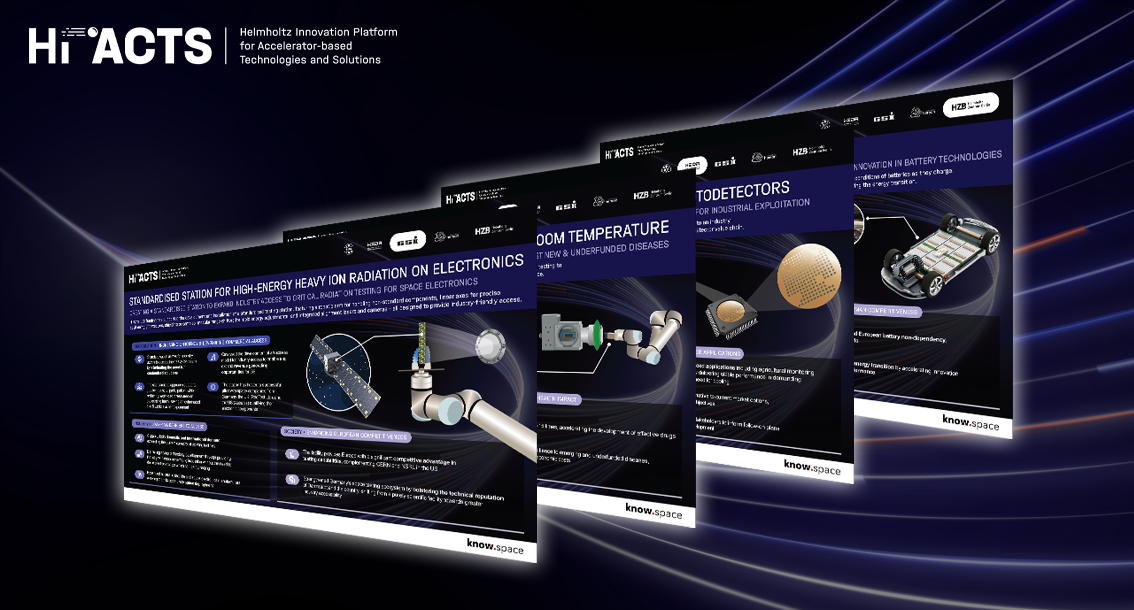
Two initial assessments were used as pilots to test and refine the framework. The resulting approach was then applied to the remaining projects and designed to support consistent future assessment beyond the initial study. Findings were presented through detailed case studies and concise visual infographics.
.reporting and infographics
Explore the four Hi-Acts impact assessments to see how targeted investment in accelerator-based technologies is supporting scientific progress, commercial innovation and wider benefits for health, sustainability, industrial competitiveness and technological resilience.